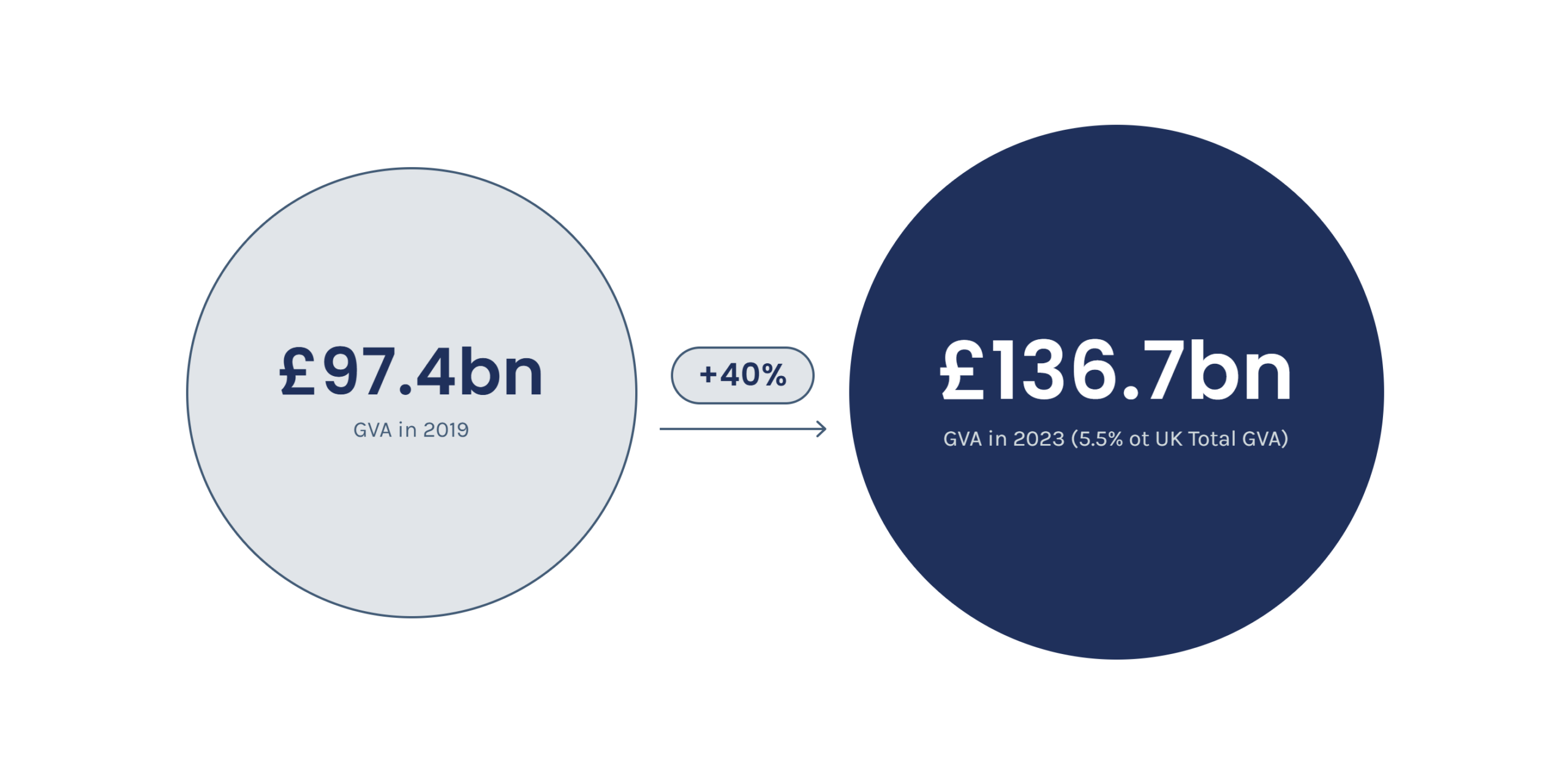
In the Design Council’s latest research, the UK design economy is valued at £136.7bn, surpassing the entire retail sector and demonstrating a major shift in the economic value of design.
The Design Economy 2026 report, published by the Design Council, is a report that showcases extensive data-driven evidence and insights measuring the economic value, scale, and impact of design across the UK.
According to their research, the UK design economy contributed £136.7bn in gross value added (GVA) in 2023, and is now larger than the UK’s entire £114bn retail sector, and almost twice the size of the £70bn accommodation and food service industry.
In this article we go beyond the headlining statistics, and dive into our key insights from the report and what it means for the Product Design sector.
Design is a strategic capability
One thing we always tell our client partners is that design isn’t a one-off creative activity, it’s a strategic way of thinking and navigating a complex issue, and the evidence shows businesses are increasingly adopting this mindset.
The report highlights that two thirds of the gross value added (GVA) created by the design economy is generated by designers working outside specialist design agencies, with around 80% of designers now working in non-design industries. Whether that’s healthcare, financial services, or energy technologies, more businesses are recognising the strategic importance of design, designers and their approach.
By embedding design capabilities, design thinking isn’t isolated to the output of commercial products and services; it’s applied strategically across all operational functions. From streamlining production, through to building robust internal frameworks, design becomes a culture for innovation across the entire business, and adds value across all of its processes.

Design in engineering-led innovation
The report provides case studies that showcase the real impact design has in adding value to products and services, and one case study is particularly close to our own work.
Leeds-based Microneedle Solutions is developing vaccination patches and applied design thinking to their innovation processes to consider the usability, manufacturability, and the overall patient experience. The result was a product that, according to economic modelling, will save the NHS between £20 and £50 per vaccination, and offer up to 97% efficacy.
This approach is exactly what we bring to the table with our MedTech projects – and our wearable sensor designs for EnMovi are a great example. By bringing design in early, alongside engineering and clinical expertise, we ensure products become intuitive and easy to use, while building a stronger commercial case for adoption.
What appeared on the surface as a science and engineering story was ultimately underpinned by design, which played a central role in its success.
“Design has been fundamental to turning this scientific innovation into a product that people can use confidently and intuitively. By considering usability, manufacturability and the patient experience from the outset, good design has helped us create a more compelling product and provided a stronger foundation for sustainable commercial growth.”
Henry Dunne, CEO and Co-Founder of Microneedle Solutions
The UK as an international design leader
According to the report, the design economy’s total export value was £88.2bn in 2022, with 80% of this export value attributed to design services, establishing the UK’s reputation as a global leader in design.
The international demand has also proven to have increased substantially, growing from £56bn in 2019 to £71bn in 2022, representing 17% of total UK service exports. That’s the equivalent to around 77% of the value of the UK financial services exports. This surging demand reflects how the UK is increasingly recognised globally for its design thinking and strategic problem solving.
It’s not only design services that are in demand overseas. Design economy goods exports (physical products such as consumer tech and furniture) reached £17.8bn in 2025, up 36% since 2020. Consumer tech products and hardware account for almost half of this (£8.7bn, up 50% since 2020), and 96% came from businesses outside the design industries. For product businesses, design is part of what international customers are buying.
Looking ahead, more international businesses will turn to our expertise to combine innovation with technical excellence to create better products, services, and systems. As a consultancy, we have seen this firsthand through an expanding platform of international client partners seeking our design capabilities to drive their growth.
A lack of diversity
Despite a general increase in design employment, over the years there has been a disappointing lack of improvement in diversity, particularly in the representation of designers who identify as women and designers from ethnic minority backgrounds.
Across the overall design sector, women only account for 25% of designers, dropping to just 9% in product and industrial design. Black designers represent 2% of the workforce, compared to 5% of the wider UK working population, while disabled designers account for 16% compared to 18% nationally.
These are staggering statistics for a sector that prides itself on human-centered processes and user understanding. In our experience, we’ve found working alongside people from diverse lived experiences and allowing them creative leadership makes for better, more inclusive products and services that deliver better experiences for people and communities.

Design is a critical, but often invisible thread that bridges the gap between innovation and adoption, and the Design Economy 2026 report brings to light the ways design is shaping the future of the UK economy.
Beyond its clear economic value, design is fundamentally a strategic way of thinking that can be applied across every facet of an organisation. Prioritising design can create a culture of innovation across an organisation, resulting in products and experiences that deliver meaningful, lasting value for people and communities, and the broader environment. It offers a framework for navigating complex problems, challenging assumptions, and connecting disparate ideas to unlock innovative solutions, and we’re excited to see how that continues to shape the growing economy around design.
Every month, we curate the information and resources our clients find most valuable into a short newsletter. They use this to stay ahead, challenge their own thinking and improve processes.
Sign up below now to get it delivered straight to your inbox.
Get More Insights Like This
Read more of our news
Tone wins two iF DESIGN AWARDS
We’re excited to announce two iF DESIGN AWARD 2024 wins for Tone, with the Henchman Tripod Ladder and Henchman Lifting Harness!
Read more